Few machines earn the loyalty a Mercedes-Benz Unimog does. Part truck, part tractor and part go-anywhere tool carrier, the Unimog has been the machine of choice for farmers, estate managers, councils and contractors for decades — because there is very little it cannot turn its hand to. If you are weighing one up, here is what makes the Unimog special, why an agricultural-registered example can be driven on a tractor licence, and what to check before you buy.
What is a Mercedes-Benz Unimog?
The Unimog (short for the German Universal-Motor-Gerät, or "universal motorised implement") is a high-clearance, four-wheel-drive implement carrier built by Mercedes-Benz. Unlike an ordinary truck, it is designed from the ground up to carry, tow, tip and power equipment — with portal axles for huge ground clearance, permanent four-wheel drive, and hydraulic and power take-off connections front and rear.
The U300 belongs to the compact, road-going "light" Unimog family — nimble enough for everyday yard and road work, but with all the Unimog toughness and versatility. It is a genuine one-machine-does-everything proposition: haulage in the week, tipping and trailer work at the weekend, gritting or hedge-cutting when the season turns.
Can you drive a Unimog on a tractor licence?
This is the question we are asked most — and it is one of the Unimog's biggest attractions. When a Unimog is registered as an agricultural vehicle (an "ag-reg" machine) and used for agricultural, horticultural or forestry purposes, it can generally be driven on a category F tractor entitlement rather than a full HGV/LGV licence.
In practice that means a much wider pool of drivers on a farm or estate can get behind the wheel, and — used within the agricultural rules — it opens up reduced road-tax and operating advantages compared with a plated commercial truck. It is always worth confirming your own licence category and intended use with the DVLA, as entitlements and conditions depend on the vehicle's registration and how it is used, but for many buyers the tractor-licence route is exactly why a Unimog makes sense where a 7.5-tonne truck would not.
What can a Unimog actually do?
The short answer is: almost anything. The longer answer:
- Tipping & haulage — a tipping body (often aluminium, with drop-down sides) shifts muck, aggregate, logs, feed and spoil around the yard and the farm.
- Trailer work — with hydraulic lines, air trailer brakes and a 7-pin plug it will run and tip a trailer, and a pick-up hitch handles agricultural trailers and implements.
- All-terrain access — portal axles and permanent 4WD get it across fields, tracks and rough ground a normal lorry could never reach.
- Attachments — over its life a Unimog can carry gritters, snow ploughs, hedge and verge cutters, cranes, tanks and more, thanks to its mounting points and hydraulics.
- Road-legal versatility — unlike a slow tractor, a Unimog is happy at road speed between jobs, so it earns its keep as transport as well as a tool carrier.
Who buys a Unimog?
Because it does the work of several machines, the Unimog appeals to buyers who need flexibility without running a whole fleet: farms and mixed estates, groundworks and civils contractors, equestrian yards, tree surgeons and forestry, smallholders, and councils and utilities for gritting, verge and access work. It is also a machine with a genuine following — good examples are sought after and tend to hold their value well.
Buying a used Unimog — what to check
A Unimog is built to last, but as with any hard-working machine it pays to buy on condition. Look at:
- Hours and kilometres — a low-hours, low-mileage example that has "not done a lot from new" is worth paying for; the drivetrain is durable but originality and light use matter.
- Tyres — Unimog tyres are a real cost, so a fresh set all round is a genuine saving.
- Hydraulics and trailer gear — check the hydraulic lines, tipping action, pick-up hitch, air-brake connections and 7-pin plug all work as they should.
- Body and chassis — an aluminium body resists corrosion well; check the sides, floor and mountings, and look over the chassis and portal axles.
- Registration — confirm the vehicle is genuinely ag-registered if you intend to drive it on a tractor licence.
- Service and presentation — a tidy, cared-for machine that has been properly maintained (and valeted for sale) usually reflects an easier life.
The Unimog U300 we have for sale
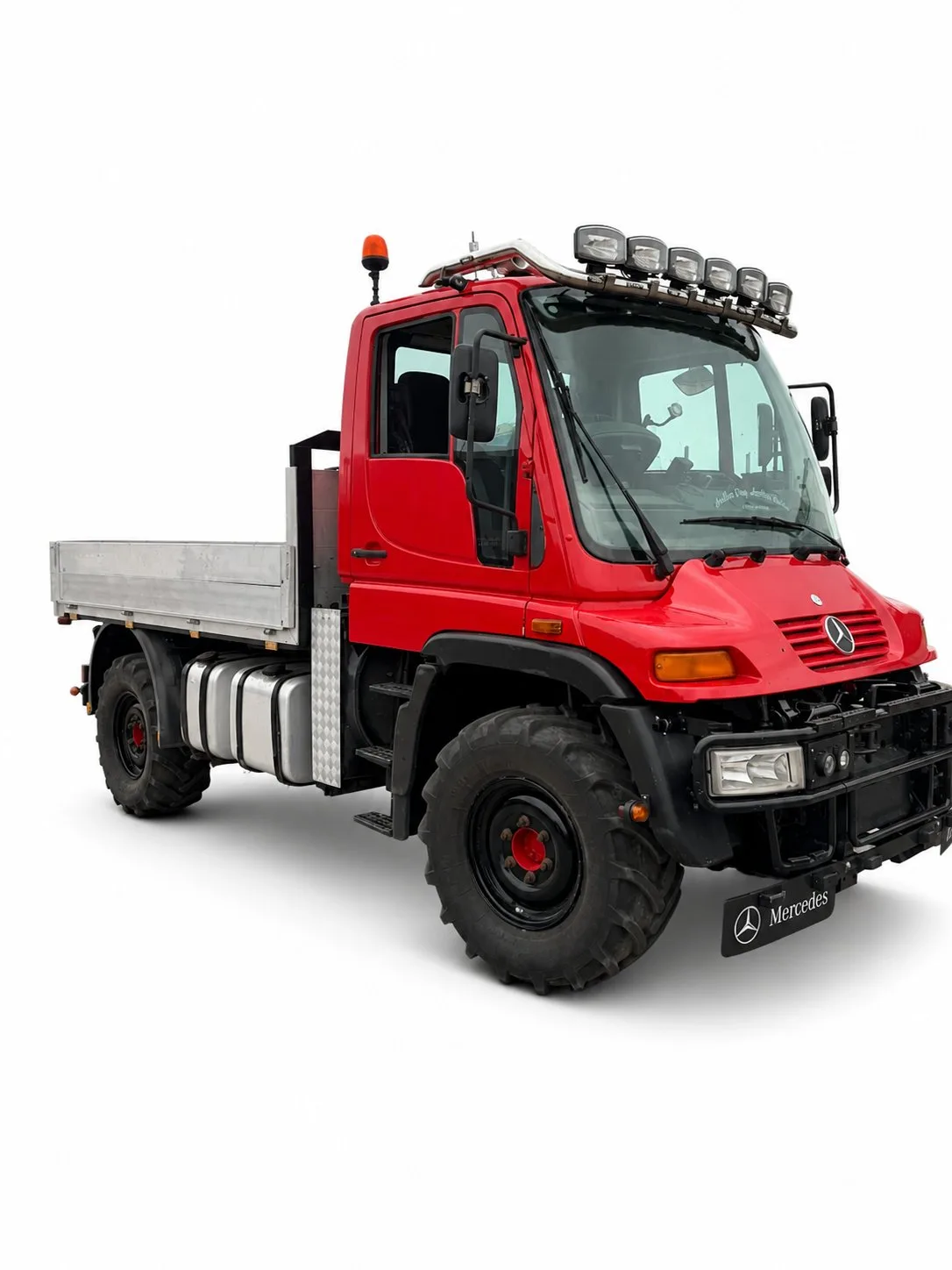
We currently have a superb 2003 Mercedes-Benz Unimog U300 for sale — agricultural-registered so it can be driven on a tractor licence, and a genuinely low-use example at just 5,412 hours and 86,243 km from new.
It runs an aluminium tipping body with drop-down sides, full hydraulic lines that will also run a tipping trailer, a pick-up hitch, air trailer brakes and a 7-pin plug — plus Hadley air horns, a flashing light bar, a Kelsa high bar with lights and a low bar with mud flaps and lights. It has brand-new tyres all round and will be fully valeted on sale.
£40,000 + VAT ONO. Nationwide delivery and worldwide export can be arranged, and finance is available subject to status. To arrange a viewing or ask anything at all, see the full details and photos, call Ivan on 07810 561230 or Archie on 07502 847710, or send an enquiry through the listing.
New to buying this kind of machine? Our guides to machinery finance and delivery & worldwide export explain how the rest works.
Looking to buy or have a question?
Browse our stock or get in touch — we're always happy to help and offer honest advice.